Table of Contents
- Understanding Credit Card Numbers in Payment Processing
- Preparing for Credit Card Number Management
- Step 1: Identify the Structure of Credit Card Numbers
- Step 2: Decode the Issuer Identification Number (IIN)
- Step 3: Verify the Check Digit for Accuracy
- Step 4: Differentiate Credit Card Numbers from Routing Numbers
Understanding Credit Card Numbers in Payment Processing
As mentioned earlier, the credit card number acts as the Primary Account Number (PAN), and its primary identifier is also used as the key in payment processes, making the PAN the main piece of cardholder information being focused upon. For the protection of this important information, we follow the PCI DSS v4.0 standards, which will be effective in 2026, and require the use of two types of authentication for administrative access into any system housing PANs. The PAN is then replaced with a non-sensitive token using the process called tokenization, which will minimize the scope of the data to protect and lessen the chances for the exposure of the information. Vulnerability scans run quarterly on internet-facing assets by an Approved Scanning Vendor and identify and correct weaknesses in those systems. Any encryption on the PAN in transit and at rest must also remain strong. staff training in security awareness and phishing prevention is another requirement now included in this framework. All these controls laid out in this PCI DSS v4.0 Compliance Guide create the basis necessary to ensure safe payment processing and will ready any merchant in charge of cardholder data in performing their own job functions on a day-to-day basis.
Key Takeaways
- As threats against payments become more sophisticated, organizations need to build up their defenses before they get into possession of any credit-card information.
- A payment card consists of four parts: major industry identifier (MII); issue identification number (IIN); individual account number; and check digit.
- There are several locations where you can find this sixteen-digit account identifier, but they all have small differences in how the entire number is displayed.
- After mapping out exactly where cardholder data lies within your systems, the next step would be making sure the proper security measures are being taken as required by the standard PCI DSS 4.0’s compliance rules.
- For example, securing payment data means being mindful of every single credit card number your business manages on an ongoing basis.
Preparing for Credit Card Number Management
As threats against payments become more sophisticated, organizations need to build up their defenses before they get into possession of any credit-card information. The updated framework allows us to be flexible in terms of security measures to suit our unique operational environment while still rigorously protecting credit-card information.
A central tenet of PCI DSS 4.0 is the mandatory use of Multi-Factor Authentication (MFA) for all administrative access to systems with credit card data. Beyond access controls, the standard strongly advocates for tokenization — replacing actual card numbers with non-sensitive digital tokens — to dramatically reduce our compliance scope and the impact of a potential breach. Equally critical is the formal requirement for staff security awareness training, ensuring our team can identify phishing attempts and secure physical payment terminals before they are ever permitted to manage cardholder information. Finally, compliance now depends on continuous monitoring, which mandates scheduling quarterly vulnerability scans through an Approved Scanning Vendor (ASV) to proactively identify and remediate system weaknesses.
Having figured out what actions need to be done in terms of compliance for such services, the following logical action should be to figure out how credit card numbers fit into this structure we’ve created to keep them safe from the internet.
Step 1: Identify the Structure of Credit Card Numbers
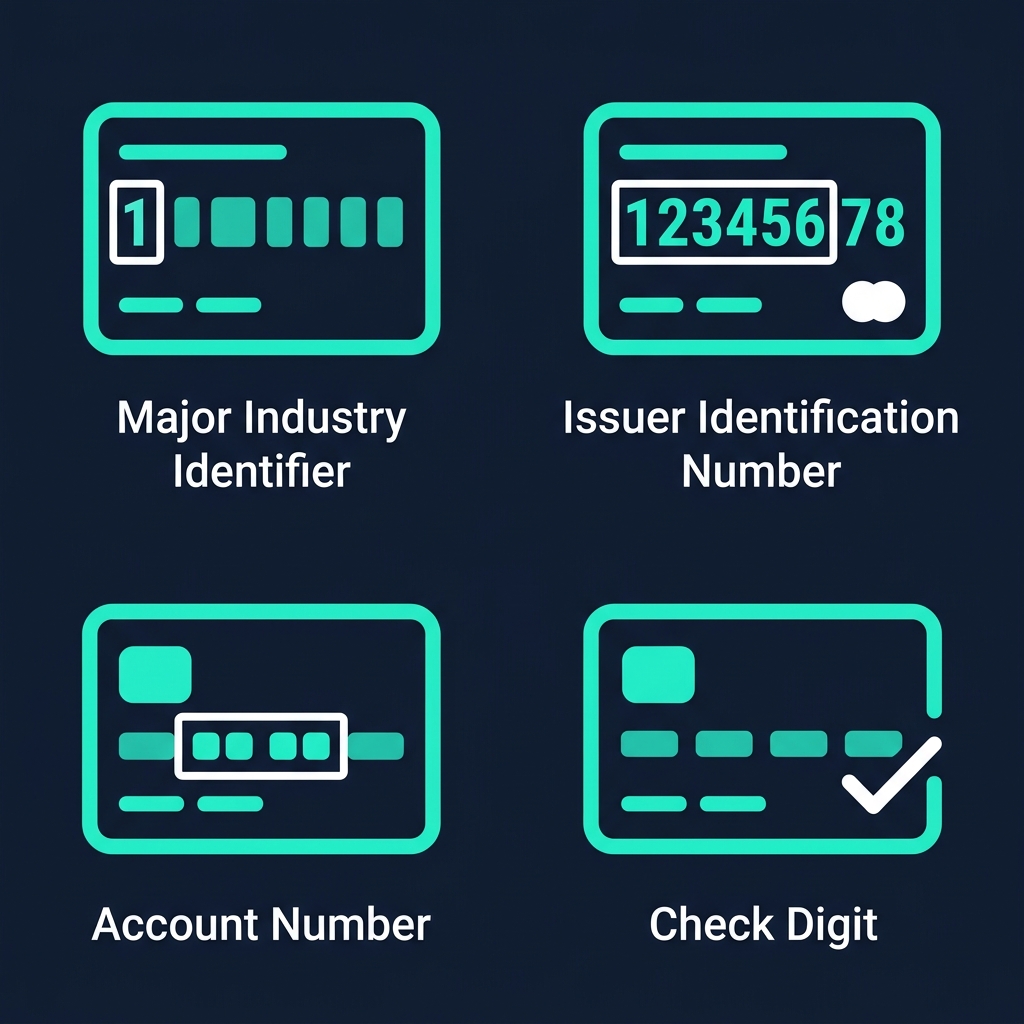
A payment card consists of four parts: major industry identifier (MII); issue identification number (IIN); individual account number; and check digit. The initial digit in a payment card corresponds to the card organization. Visa numbers start with ‘4’, Mastercard with ‘5’, American Express with ‘3’, and Discover with ‘6’. The first six digits are referred to as the IIN; they specify the issuing bank, network, and card program. Digits from the seventh through the fifteenth represent the cardholder’s account number. Final digit is a check digit calculated using the luhn formula. This is an example of a credit card number. Most credit cards consist of 16 digits. However, there are also 15-digit cards such as American Express.
Step 2: Decode the Issuer Identification Number (IIN)
Taking into account a basic look at how cards might work, we know there will be a few numbers for the IIN, i.e., those six digits that help identify what payment networks the card can go through, and which specific bank actually handed out the card. So using just these simple little numbers helps us determine where exactly a payment card came from.
This will be the first figure within the series, and it’s referred to as Major Industry Identifier (MII), which identifies what the card network is. Almost all Visa card numbers begin with the digit ‘4’, while most Mastercard numbers start off with ‘5’ and the ones for American Express cards start out with ‘3’. The following five numbers in a IIN represent the particular issuing bank. We would need to consult either an on-line database or a table to locate the corresponding provider but just knowing the MII is enough to confirm that the card belongs to a valid network.
Now that we’ve extracted the data on the card issuer, the only thing left to do would be to make sure the remaining digits are all valid numbers, particularly the check digit.
Once the issuer has been identified based on the first six digits of a credit card number, the card’s integrity can be verified through its check digit. The check digit is a value at the end of a string which can be derived from the rest of the sequence according to the Luhn algorithm, a simple formula used to ensure that any number that was entered in the course of data capture does not contain common typos. First, starting from the right-hand side digit (excluding the check digit), the value of every second digit is doubled, working left across the string. When doubling results in more than a single digit, those digits are summed. After this process, all the doubled numbers and the other remaining figures are added together, and the check digit is included. If the total is evenly divisible by 10, the number passes the Luhn validation.
This only looks for errors such as single digits that may be wrong, or two adjacent numbers out of position, but it’s not meant to be a security measure at all. The check digit will confirm if the numbers on the card match up the way they should, thus allowing us to distinguish between cards and routing numbers, because their purposes are different.
Step 4: Differentiate Credit Card Numbers from Routing Numbers
Once our credit card number has gone through validation for its final digit, it will have been identified as something other than a routing number, since this type of bank account information would serve an alternative purpose.
The card account number (15-16 digits) identifies the cardholder’s account. It’s printed on the front of a payment card and, during a transaction, routes the payment through the card network for authorization.
Routing numbers have always been a nine-digit code that identify your bank, not your account number. Routing numbers will never be on your credit card as compared with the account number. Routing numbers are found on checks in bottom left corner along with your statement from the bank. The numbers also help you when using direct deposit or when transferring money viaACH.
Card account numbers refer to accounts used in card payment transactions, whereas routing numbers provide directions to banks in case you need to perform a bank transfer electronically. It helps keep those two types separate when setting up your account to prevent errors. After that, we have located what a card account number is and where it should be placed on your debit card and digital wallets.
Step 5: Locate Your Credit Card Number Across Platforms
There are several locations where you can find this sixteen-digit account identifier, but they all have small differences in how the entire number is displayed.
- On the physical card, the number is typically embossed across the front, though some newer issuers print it on the back to reduce visibility.
- Inside a mobile wallet, tap the card and then the info icon (Apple Wallet) or the three-dot menu (Google Pay); you will need to authenticate with Face ID, Touch ID, or your fingerprint before the full digits appear.
- In online banking or your card issuer’s portal, navigate to the account details or card information page, where the number is usually masked — select “show number” and re-authenticate to display it in full.
- Check the statement’s format; if only a masked version is visible, use the authenticated digital methods above.
After you get your hands on this data, make sure you take steps to protect it right away.
Step 6: Protect Cardholder Data with PCI Compliance
After mapping out exactly where cardholder data lies within your systems, the next step would be making sure the proper security measures are being taken as required by the standard PCI DSS 4.0’s compliance rules. In 2026, version 4.0 superseded version 3.2.1 and gave way to a customized security policy based on the company’s individual risks rather than a checklist.
The PCI DSS 4.0 compliance manual states that two factor authentication must be used in order to allow access to cardholder information from admin accounts. Tokenizing data means that you substitute sensitive info with less sensitive stuff which effectively narrows down the compliance scope.
Internet-facing systems must be scanned at least once every quarter by an Approved Scanning Vendor (ASV), and employees must receive formal training covering phishing awareness and password policies.
PCI-DSS 4.0 focuses on continuing monitoring and this transforms PCI DSS from being something done once to something which is done all the time. It forms the technical and procedural basis for ensuring you can safely handle payment data within your POS system.
Step 7: Integrate Card Number Handling in Your POS System
The Payment Account Reference (PAR), which functions as a non-financial identifier for linking payments over time, can help prevent customer data loss from card tokenisation and replacement of cards without revealing sensitive information about the card holder. According to the U.S. Payments Forum, PAR works by tying tokens and reissued card numbers together and ensures that customers’ purchase histories stay intact if they change their physical card.
PAR is a 29-character alphanumeric field: a 4-character EMVCo prefix followed by a 25-character unique value. It is an identifier, not a payment credential.
- Reconciliation — match transactions across replacements and token swaps
- Fraud detection — identify unusual activity tied to the same account
- Loyalty tracking — connect purchases to customer profile regardless of device
It is recommended that we treat this information like other types of sensitive cardholder data when doing so. We recommend obtaining user consent and documenting privacy disclosures. When integrating PAR into transactions, ensure that we configure payment devices and POS systems to include and save all the PAR in the transaction record.
Resolving Common Credit Card Number Challenges
For example, even if the system supports auto-capturing your credit card number at checkout, things could still go haywire from time to time because customers might have typed in their numbers incorrectly, or maybe their cards were rejected for some reason. Having a few simple rules will be enough most of the time to make everything run smoothly at your store.
- Incorrect formatting: Spaces, dashes, or other symbols in the card-number field cause POS software to reject the entry. Most systems expect a continuous string of digits; re-entering the number without any punctuation usually clears the error.
- Mistyped digits: A single transposed or missed digit creates a number that does not match any valid card account. The POS cannot tell the difference between a genuine card and a mistyped one until it checks length and structure. Staff should confirm the number against the physical card and re-enter carefully if an error appears.
- Failed Luhn check: Virtually all card numbers follow the Luhn algorithm, a straightforward formula that detects transcription mistakes. When a number fails this internal checksum, it is not a valid payment card. A quick re-entry almost always resolves the issue.
Should the same card number repeatedly trigger errors despite careful entry, the cause likely lies with the card issuer or the merchant account setup. Contact your payment processor for further diagnosis. Our team at POS Brokers can assist with persistent card-number troubleshooting and ensure your terminal settings are correct. With these everyday issues resolved, merchants can turn their attention to stronger card security through encryption and tokenization.
Frequently Asked Questions
What is credit card number
A credit card number is the Primary Account Number (PAN) that identifies the cardholder’s account. It contains a major industry identifier (Visa starts with 4, Mastercard with 5, American Express with 3, Discover with 6), an issuer identification number, an individual account number, and a check digit used for validation.
How long is a credit card number
Most credit card numbers are 16 digits long. American Express cards are the common exception, using a 15-digit format. The standard 16-digit length applies to Visa, Mastercard, and Discover, and the full string acts as the primary account identifier during transactions.
Does a credit card have a routing number
No, a credit card does not have a routing number. Routing numbers are nine-digit codes that identify a bank for electronic transfers and direct deposits. They appear on checks and bank statements, not on credit cards, which use an account number for payment processing.
How to find credit card account number
The credit card account number is the 15- or 16-digit number printed on the physical card, usually embossed on the front. Some newer cards print it on the back. In a mobile wallet, tap the card and authenticate with Face ID, Touch ID, or fingerprint to view details. In online banking, go to account details, select “show number,” and re-authenticate to see the full digits.
Mastering Card Number Security for Your Business
For example, securing payment data means being mindful of every single credit card number your business manages on an ongoing basis. For us, security isn’t just a buzz word, but rather an attitude and practice that demands regular audits, learning new things all the time, working with a processor who keeps in mind that they will be held accountable. On top of this, we don’t hide anything from you. Your personal contact information does not get sold to other businesses; if you’re part of our mailing list, it’s easy enough for you to ask not to receive future mailers; as a matter of fact, all offers are made under certain conditions which must be met. Our policy regarding shipping states that there might be some problems caused by the carrier, beyond our responsibility. Yet, each deal represents another opportunity to show how much you care about paying customers’ safety. And again, we will do everything within our power to make sure that that goal is met.
Implement Secure Card Handling Today
Now that you understand the anatomy of credit card numbers—from the Issuer Identification Number to the Luhn check digit—it is time to ensure your payment environment is equally precise. The PCI DSS 4.0 requirements you have learned about, such as multi-factor authentication and tokenization, demand a POS system built for compliance. The POS Brokers can help you select hardware that integrates these security standards and reduces your risk of a data breach. With a lifetime warranty and no setup fees on qualifying offers, you can upgrade your payment processing with confidence. Our team of experts will guide you through the entire process, from system selection to compliant installation. Secure your customers’ trust by protecting every credit card number that passes through your business. Start with a complimentary consultation today.
Implement Secure Card Handling Today
Resources