Table of Contents
- Visa Debit Card Acceptance: What Every Merchant Needs to Know
- How Visa Debit Card Transactions Work and What They Cost Merchants
- Accepting Visa Debit Cards Across POS Systems, Terminals, and Checkout Environments
- Managing Visa Debit Card Refunds, Disputes, and Day-to-Day Processing Operations
- Choosing Interchange-Plus Pricing and Hardware for Visa Debit Card Processing
- Visa Debit Card Questions Merchants and Cardholders Ask Most
- Get Started with Visa Debit Card Processing
Visa Debit Card Acceptance: What Every Merchant Needs to Know
When you accept a Visa debit card, your consumers can pay straight from their bank account at the time of purchase, providing another means to choose for clients in the checkout procedure. For merchants, these transactions introduce a layered cost structure that includes Visa interchange fees, network assessments, and the processor markup your provider adds.
Typically, interchange fees make up the largest share of a merchant’s total processing cost, so understanding this structure helps you choose the right pricing model for your business. Therefore, if you want to know why interchange fees can seem so complicated, start there first. This type of fee is a non-negotiable “wholesale” rate set by Visa. It varies depending on whether the customer is present during the transaction (card-present), or if they’re not (card-not-present) and your business’ industry risk level. The total amount you end up paying will depend heavily on your processor as well – some charge a flat fee and others go off of Interchange Plus. If you pay out of Interchange Plus, it means you’ll see more of the interchange fee in your statement than if you’re using flat-rate pricing.
We’re going to clarify for you how Visa debit card transactions operate as well as what merchants should pay in fees so that you will be able to make appropriate choices when setting up your own payments.
Key Takeaways
- In short, anytime someone makes a payment via their visa debit card, the money goes on quite the journey from where it started to its eventual destination.
- If you’re upgrading your checkout solutions, you need to know exactly where and how a visa debit card can be accepted to minimize costs and maximize speed.
- With that behind them, the next item in their budget is how much they pay based on which pricing model applies.
- People here hear merchants and cardholders ask the same practical questions about Visa debit card transactions every day.
- By understanding the way in which visa debit card processing costs are calculated by interchange fees, merchants can make smarter choices about using transparent pricing models which disclose the full cost.
How Visa Debit Card Transactions Work and What They Cost Merchants
In short, anytime someone makes a payment via their visa debit card, the money goes on quite the journey from where it started to its eventual destination. There may be all kinds of fees along the way to reduce any given company’s profit margin for the purchase. By knowing the structure behind those fee charges and costs, you’ll make more educated decisions as a businessman and know what type of prices you should really be accepting.
The Three Layers of Processing Costs
There were three distinct fees incurred on each transaction. First was the interchange fee, which was a non-negotiable wholesale rate imposed by Visa and varied based upon the types of transactions and merchant’s risk profiles. Then there were the network assessments, smaller flat fees charged for funding the card networks’ operation. Lastly there was the processor markup, the only negotiable portion, added by the payment processor to recover their own overhead, including service, support, and equipment expenses. All three layers combined made up the full cost of accepting a Visa debit card.
What Determines the Assigned Interchange Rate
What merchants pay varies based on three factors that Visa sets: The card type determines its interchange cost: standard debit cards are generally near the low end, but premium or rewards-linked debit cards can climb into the upper end. Transaction capture method matters too; contactless tap-and-pay transactions in the United States usually incur lower fees than manually keyed card-not-present payments. The merchant category code (MCC) is another determinant of interchange costs: retail and restaurant categories often pay less than higher-risk sectors. In 2026, the wholesale interchange range is from 1.15% +$0.05 to 2.40% +$0.10.
Flat-Rate vs. Interchange-Plus Pricing for Visa Debit Processing
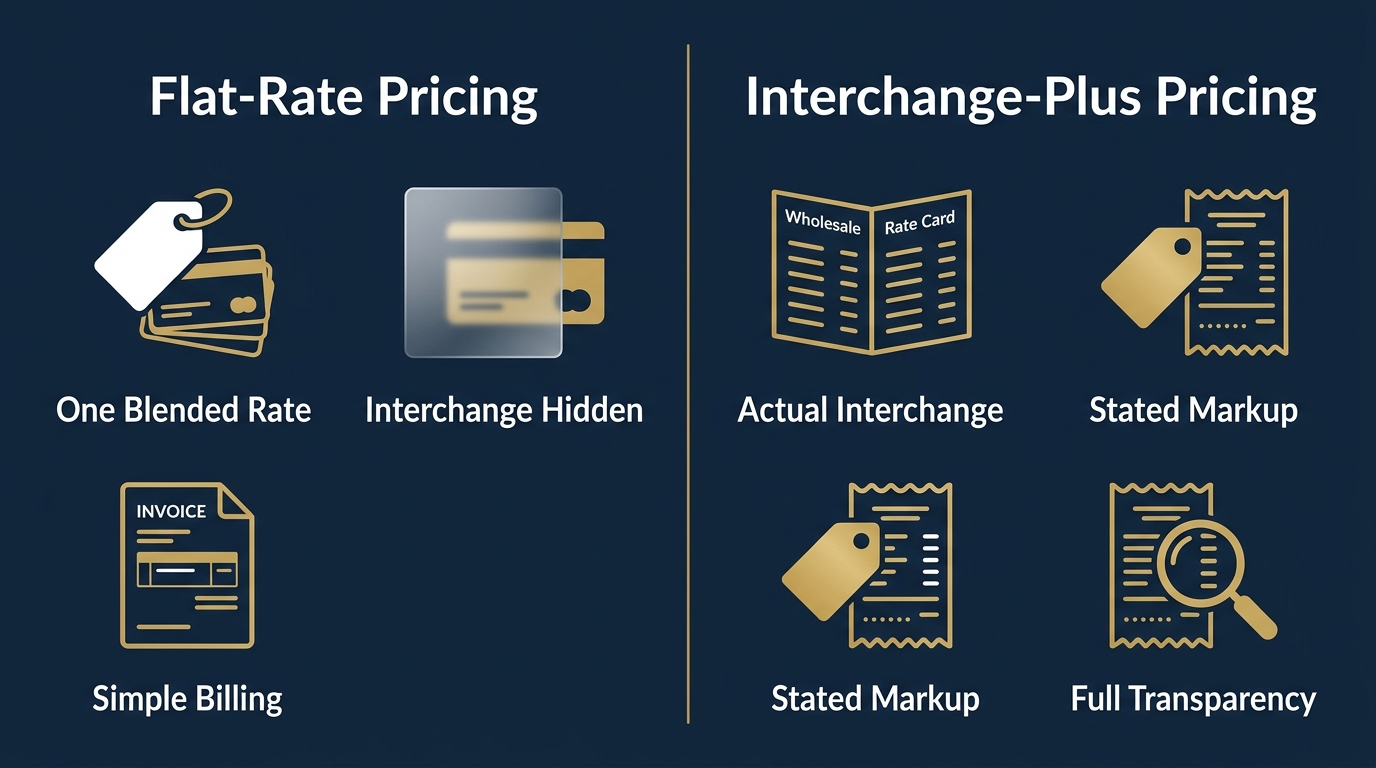
| Pricing Element | Flat-Rate Pricing | Interchange-Plus Pricing |
|---|---|---|
| Cost Input Parameter | A single blended per-transaction rate regardless of underlying interchange | Actual interchange plus a stated processor markup |
| Interchange Layer Classification | Interchange variation is hidden inside the blended rate | Wholesale interchange passed through and shown separately |
| Assessment and Processor Differential | Assessments and markup folded into one flat price, obscuring variations | Assessments and markup separated for full cost transparency |
Instead, interchange-plus pricing separates the wholesale fee charged by Visa from the processor’s explicit markup, giving merchants full visibility into where every dollar goes. Flat-rate pricing packages everything into a single lump sum, which can mask the true interchange variation and make it harder for merchants to spot savings opportunities.
For businesses that process lots of Visa debit card transactions, the transparency of interchange-plus typically outweighs the convenience of flat-rate pricing.
Accepting Visa Debit Cards Across POS Systems, Terminals, and Checkout Environments
If you’re upgrading your checkout solutions, you need to know exactly where and how a visa debit card can be accepted to minimize costs and maximize speed. This includes whether this is done at the countertop, either through a gateway or a mobile solution, but either way that solution determines the cost of transacting the sale and how long the customer needs to spend at the till.
Card-Present Acceptance: Terminals, Readers, and Tap-to-Pay Hardware
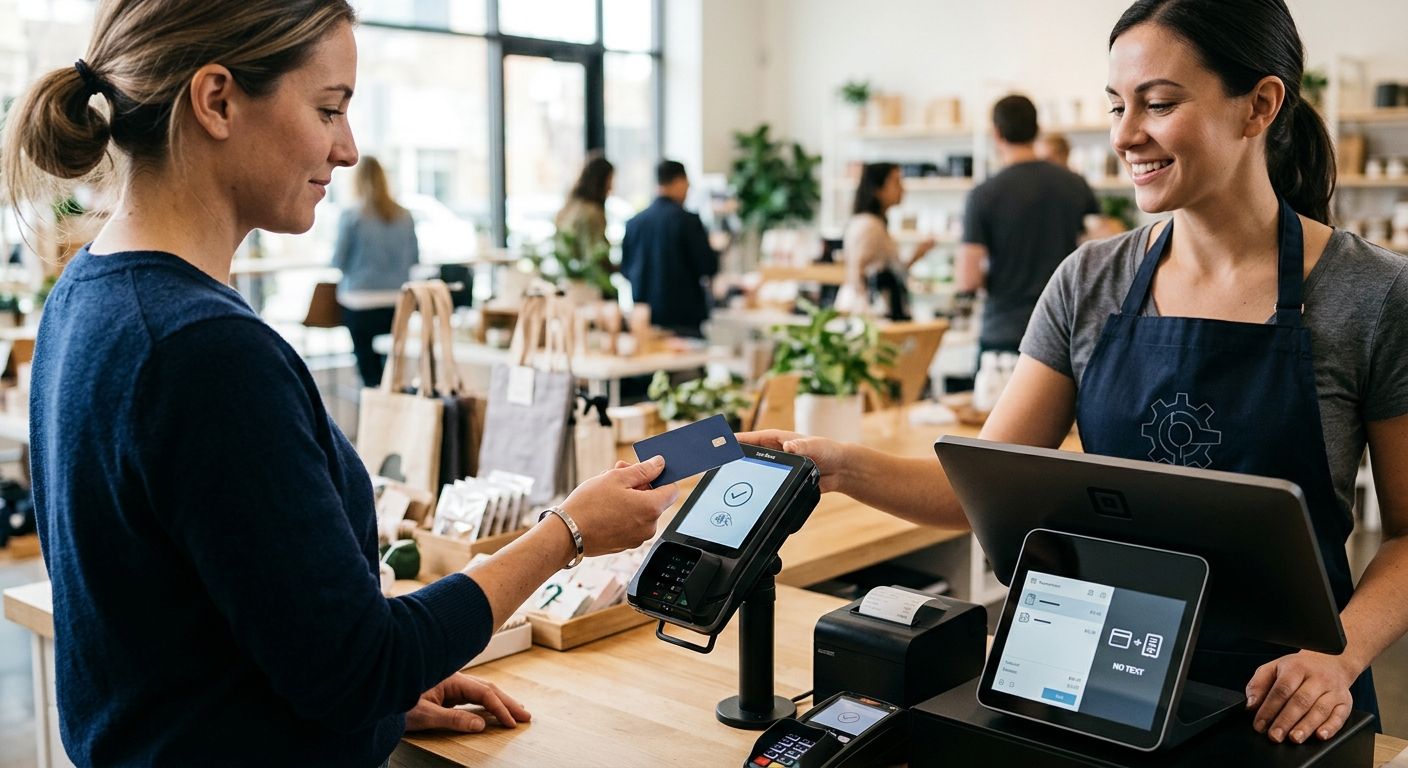
In modern terminals there are three primary ways to accept a visa debit card in person, dip (EMV chip), tap (NFC contactless), or swipe (magnetic stripe). But EMV chip readers remain the standard for security. With the second type, however, transactions are completed much faster, under 500 milliseconds, while chip insertions usually take from 3 to 10 seconds.
Security is equally critical. NFC contactless payments use tokenization, replacing the card number with a single-use digital token for each transaction. This approach, governed by PCI Security Standards Council, EMVCo, and NFC Forum standards, prevents cloning and replay attacks that plague magnetic stripe swipes. Hardware like the Clover Mini arrives NFC-ready out of the box, so businesses upgrading from older systems often need only a software update to enable tap-to-pay.
| Capture Method | Typical Fee Profile | Transaction Speed |
|---|---|---|
| Contactless Preference Profile | Lower interchange fees than keyed-in card-not-present | Under 500 ms |
| Consumer Payment Behavior Context | 70% of U.S. consumers projected to use mobile wallets by 2026 | Faster checkout drives adoption |
The cost savings from using a contactless payment method also means there will be less waiting in lines, which makes it popular among new merchant account holders. Many customers get offered more affordable equipment such as the Clover Mini when they sign up for a card reader, encouraging them to upgrade their point-of-sale system without spending too much money.
Card-Not-Present: E-Commerce Checkout for Visa Debit
Online merchants process a visa debit card using a payment gateway, which then sends transactional information about that card through to the card network. Keyed In, Card Not Present transactions face higher interchange rates, typically closer to the top end of the 1.15% + $0.05 to 2.40% + $0.10 range, because they carry elevated fraud risk compared to Card Present. The tokenized checkout flow can help lower these interchange costs and also improve authorization rates for companies like Shopify or WooCommerce with Clover integration.
Merchants should use interchange-plus pricing so they can see the network fee clearly separated from processor markups. That transparency helps identify when a gateway’s flat-rate model is masking higher underlying costs. For high-volume e-commerce sellers, routing optimization tools can steer transactions to the lowest-cost interchange tier while maintaining a seamless checkout experience.
Visa Debit Processing for Restaurants, Retail, Mobile, and Online Sellers
Every industry has distinct needs for accepting a visa debit card. Full-service restaurants benefit from countertop terminals like countertop terminals that handle both table-side and bar payments, while counter-service spots can use compact contactless readers for quick, contactless transactions. Retailers often pair a station-style terminal with barcode scanners and receipt printers to speed up checkout lines, while mobile vendors rely on portable terminals to accept payments anywhere.
Online sellers integrate payment gateways with their e-commerce platforms, ensuring tokenized flows for both desktop and mobile shoppers. Our team maps each business to the right hardware and software stack, from Revel for full-service restaurants to ShopKeep for retail and Lavu for quick-service venues. Click here to qualify for your free POS system and start accepting Visa debit cards with the hardware and pricing that fit your operation.
Managing Visa Debit Card Refunds, Disputes, and Day-to-Day Processing Operations
When a visa debit card purchase has been authorised through the terminal, then the next part of the process would be refunds, disputes, as well as ensuring that all aspects of the workflow are running smoothly. We help merchants navigate these processes efficiently to maintain customer trust and operational clarity.
How Visa Debit Card Refund Timelines Work for Merchants and Customers
Typically for a merchant initiated refund on a visa debit card there would be a waiting time between five and fourteen business days before funds show up on the cardholders’ statement. The timeframe starts from when the merchant sends a reversal request through the payment processor. Merchant initiated reversals may take more time in some cases because the issuer might need further information prior to processing the refund. Other times delays might occur due to a large volume of transactions that have been sent during holidays or other busy periods. Merchants should communicate this timeframe clearly to customers to set accurate expectations and reduce follow-up inquiries.
Visa Debit Resolution Paths: Refunds, Billing Errors, and Chargebacks
| Resolution Path | Typical Timeline | Key Requirement |
|---|---|---|
| Refund | 5–14 business days after reversal | Merchant-initiated reversal |
| Billing error notice | Within 60 days of statement date | Written notice to issuer |
| Chargeback | Resolved through Visa Claims Resolution process | Active dispute framework |
The decision will depend upon the circumstances surrounding the incident. A refund is appropriate when the merchant initiates a reversal, but a billing error notice would be necessary if the customer disputes an error on his statement. If there was fraudulent activity or the card was used without authorization, a chargeback must be made through the Visa Claims Resolution procedure. Each step should be documented in order for the merchant to comply with the guidelines as well as to protect himself against future problems.
Handling Chargebacks, Billing Error Notices, and Friendly Fraud
The Visa Claims Resolution Process will be followed if a customer submits a chargeback. While the transaction is pending, the issuer cannot bill for the amount in question nor can they impose any interest charges upon such amount, or report that the account holder is delinquent. Consumers receive protection from this action during their claim against a merchant. For billing error disputes, the customer shall submit a written notice to the issuer within 60 days of the statement date to retain legal protections under the Fair Credit Billing Act. The merchant should then promptly respond to the customer’s written notice of the billing error to avoid escalation.
A merchant can challenge friendly fraud, where a cardholder disputes a transaction that was properly performed, through Visa’s new Compelling Evidence 3.0 guidelines. Two or more previously undisputed transactions can be submitted with common characteristics, including the device used to make the purchase, the buyer’s IP address at the time of sale, or delivery confirmation. The goal is to present this evidence in order to undo illegitimate charges and avoid lost money due to the cost of a chargeback.
Setting Up Merchant Accounts for Same-Day Visa Debit Processing
Streamline merchant account set up and process visa debit card transactions easily. Qualifying merchants can activate their accounts on the same day they sign up and accept payment right away. Next-day deposit means merchants will have cash in hand fast to meet immediate expenses, without any fees attached to setting up or canceling an account. Qualified merchant might be able to receive free or discounted equipment like Clover Minis, which lets them take care of all payments at once.
In order to run things efficiently on a day-to-day basis you will need a correctly configured merchant account. Authorizations occur at the terminal, transactions are batched for settlement, and reversals are handled through the processor’s dashboard. With same-day activation and transparent pricing, merchants can focus on growth instead of administrative hurdles.
Choosing Interchange-Plus Pricing and Hardware for Visa Debit Card Processing
With that behind them, the next item in their budget is how much they pay based on which pricing model applies. The interchange-plus pricing plan differentiates between the wholesale Visa interchange rates and the markup set by their credit card processor, offering more insight into how much each merchant pays. For visa debit cards, interchange rates are usually ranging between 1.15% plus $0.05 up to 2.40% plus $0.10 per transaction, again depending on several factors including the card used, how captured, merchant category code and the amount of risks involved for the merchant. This format works well when looking at higher volume merchants that need to see exactly how their credit card fees break down rather than being given a single rate that doesn’t account for those factors.
Hardware selection plays a key role in both cost and speed. Contactless (tap) Visa debit transactions usually carry lower fees than card-not-present keyed-in payments, making NFC-capable terminals a smart choice. These terminals process tap transactions in under 500 milliseconds—far faster than the 3–10 seconds required for EMV chip inserts—potentially improving checkout speed by up to 30% in busy environments. New merchants may qualify for discounted hardware such as a mini NFC terminal, which supports both NFC and EMV while integrating seamlessly with most POS systems.
Take into consideration if the reader supports NFC/Contactless, whether it can read chips in cards as well (EMV), what size and shape is the reader to suit your specific needs and which POS system you want to integrate it with. All these features can save money on transaction fees while making customers pay via card or mobile device quicker and in a safe environment. Both merchant and consumer will benefit when using NFC, because it offers increased transaction speed and added security due to worldwide accepted standards by EMVCo, PCI Security Standards Council and NFC Forum.
Visa Debit Card Questions Merchants and Cardholders Ask Most
People here hear merchants and cardholders ask the same practical questions about Visa debit card transactions every day.
What determines the interchange rate on a Visa debit transaction?
The total fees a merchant will pay will vary depending on what kind of card customers use, how the transaction is captured, and the merchant’s industry risk profile.
Do contactless payments cost less to process than keyed-in ones?
Yes. Contactless transactions typically carry lower fees than card-not-present keyed-in payments.
How long does a Visa debit refund take to post?
The process for getting a refund from your Visa debit card can take anywhere between five to fourteen business days following when the store submits a credit back request.
What happens to a disputed charge while a claim is pending?
In case of an ongoing dispute, the issuer cannot collect the disputed amount, charge interest on it, or report it as delinquency.
Frequently Asked Questions
What is a visa debit card
A Visa debit card is a payment card that deducts money directly from the cardholder’s checking account at the time of purchase. It functions like a debit card but carries the Visa brand for acceptance at merchants that take Visa.
How to use visa debit card for online shopping
To use a Visa debit card for online shopping, enter the card number, expiration date, and security code in the payment form. The transaction is processed through a payment gateway that routes it to the card network for authorization.
Where is security code on visa debit card
The security code on a Visa debit card is a three-digit number printed on the back of the card, to the right of the signature panel. It is used to verify card-not-present transactions.
Can i use my visa debit card internationally
Whether a Visa debit card can be used internationally depends on the cardholder agreement terms. Some cards may incur foreign transaction fees or require registration before use abroad.
How long does a visa debit card refund take
A Visa debit card refund typically takes five to fourteen business days to appear on the cardholder’s statement after the merchant initiates the reversal. The exact timing depends on the issuer’s processing schedule.
Get Started with Visa Debit Card Processing
By understanding the way in which visa debit card processing costs are calculated by interchange fees, merchants can make smarter choices about using transparent pricing models which disclose the full cost. In 2026, the range for interchange fees is expected to be anywhere from 1.15% plus $0.05 up to 2.40% plus $0.10 per transaction, keeping costs transparent as well as easy to control.
Merchants that are eligible can receive discounted hardware such as a Clover Mini. Inquire about getting a non-binding quote or talk to a professional if you’re interested in the offer.
Get Your Visa Debit Setup
You’ve now seen how interchange fees shape the total cost of every debit transaction, from the three cost layers to the 2026 estimated range of 1.15% plus $0.05 to 2.40% plus $0.10. You also know that interchange-plus pricing separates wholesale fees from processor markup, giving you clearer visibility than flat-rate structures. Capture method matters too, since contactless tap payments typically cost less than keyed-in transactions. The right hardware and pricing structure together can keep both your fees and checkout times down. If you’re ready to put these insights to work, The POS Brokers can help you review pricing and equipment options for your business. Visit our shop to explore terminal and POS system options, or call (888) 473-0780 to discuss which setup fits your debit volume.
Resources