Table of Contents
What Exactly Is Level 3 Processing for B2B?
Level 3 processing for B2B is a method of submitting enhanced, line-item transaction data along with business-to-business card payments. When a merchant captures detailed information—such as item descriptions, quantities, tax amounts, unit costs, and shipping postal codes—the card networks may classify the transaction into a more favorable interchange category. For many B2B sellers, this can translate into lower processing costs while still accepting the corporate, purchasing, fleet, and government cards that their commercial customers prefer to use.
How Level 3 Differs from Level 1 and Level 2
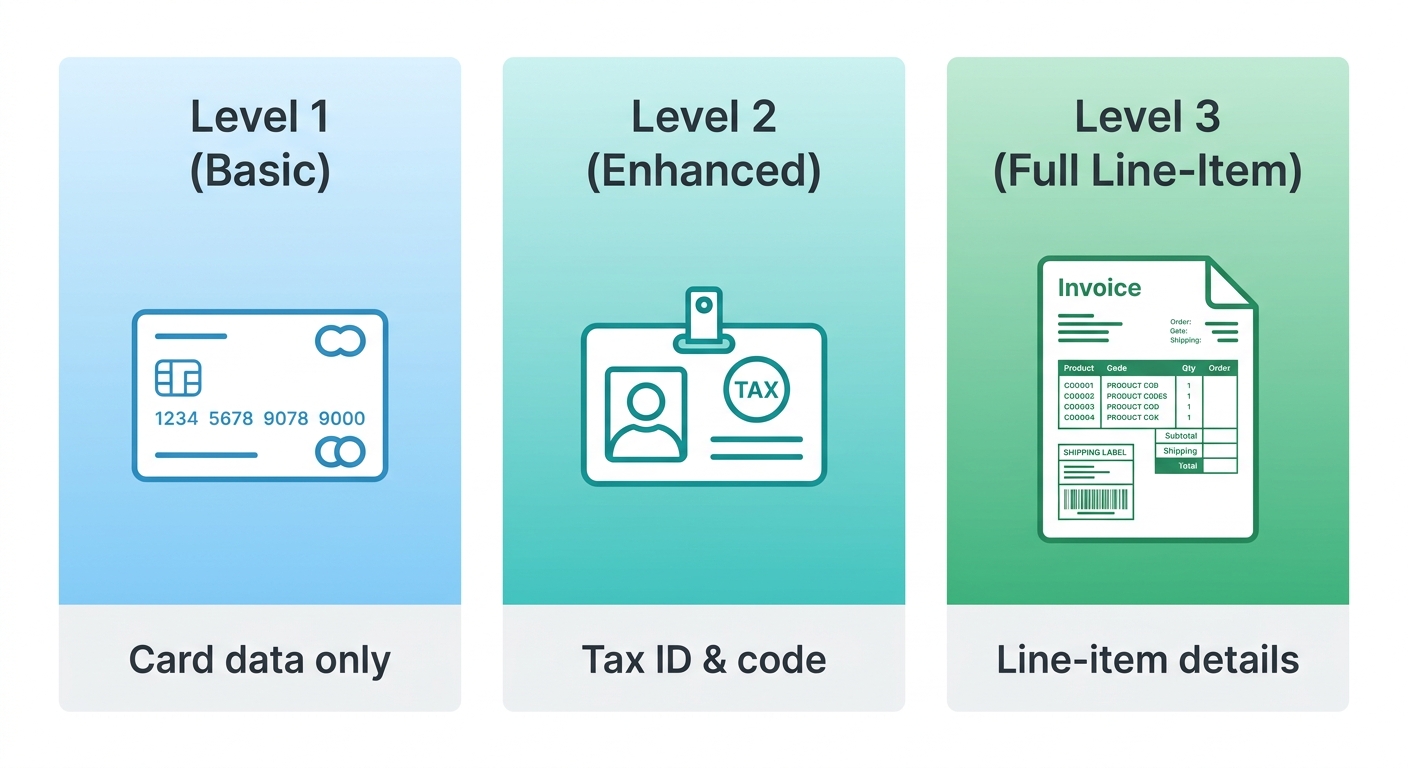
Card networks organize business-to-business transactions into three data levels, each requiring a deeper set of information. Level 1 is the simplest: it includes only the basic card data you would expect from any consumer purchase—card number, expiration date, and transaction amount. Level 2 adds two extra fields: a tax ID and a customer code, which provide slightly more context but still fall short of full invoice detail.
Level 3 processing for B2B goes significantly further. It requires a complete, line-by-line breakdown of the purchase, mirroring the detail you would find on a commercial invoice. By supplying this depth of data, eligible transactions may qualify for interchange rates that are considerably lower than those applied to Level 1 or Level 2 transactions. This difference is especially relevant for merchants who routinely accept high-ticket B2B card payments from corporate or government buyers.
Understanding the progression from Level 1 to Level 3 helps clarify why the extra data matters. The graphic below illustrates how each level builds on the previous one.
 Tres niveles de procesamiento de tarjetas para comercios
Bringing full line-item detail into the processing stream creates the opportunity for cost savings that many B2B sellers overlook. However, accessing those savings requires capturing and transmitting very specific data points.
Level 3 Data Fields at a Glance
To transmit a Level 3-qualified transaction, a merchant must include each of the following data elements on the transaction record:
- Merchant and consumer tax ID
- Customer code
- Item description
- Commodity or product code
- Quantity
- Unit cost
- Tax amount
- Freight amount
- Ship-from postal code
- Ship-to postal code
- Invoice number
When the payment gateway and processor support Level 3 data capture, these fields can often be pulled directly from the business’s ERP, accounting, or invoicing software, reducing manual entry.
Which B2B Merchants Benefit Most?
Level 3 processing for B2B is particularly relevant for merchants that regularly accept corporate, purchasing, fleet, or government cards. The businesses that stand to gain the most include:
- Wholesalers and distributors
- Industrial suppliers and trade contractors
- Manufacturers selling directly to commercial buyers
- Government and education vendors
- High-ticket B2B sellers with average transaction values in the hundreds or thousands of dollars
For these merchants, every transaction that qualifies for Level 3 interchange can reduce the effective cost of acceptance. Over hundreds or thousands of monthly payments, the cumulative savings can be meaningful.
Understanding Eligibility and Next Steps
It is important to know that Level 3 eligibility is not automatic. Whether a transaction qualifies depends on the card network, the specific card type, and the processor’s ability to capture and transmit the required data. Even if a merchant accepts the right card types, the payment setup must be configured to pass the detailed line-item information in the required format.
Our team at POS Brokers regularly helps businesses in Simi Valley and across the United States evaluate whether their current processing environment can support Level 3 data. If you would like to explore how Level 3 processing might fit into your B2B payment strategy, we invite you to speak with one of our payment specialists. They can review your existing setup and provide guidance tailored to your business’s transaction profile.
Should you pursue a new merchant account or updated hardware through us, please remember that free or discounted Clover placements and other terminal offers are available to qualifying merchants only. To begin the conversation, you can request a complimentary consultation—and if you choose to click “Get Pricing,” you consent to receive marketing calls and texts, with the ability to opt out at any time. We never sell your contact information; any data collected is used solely for order fulfillment and marketing in accordance with our privacy policy.
Placeholder
Section content pending
Tres niveles de procesamiento de tarjetas para comercios
Understanding Level 3 Processing for B2B Payments
One way B2B merchants can reduce processing costs is through level 3 processing for b2b. In simple terms, Level 3 card processing is the transmission of enhanced line-item transaction data—such as customer code, product code, commodity code, invoice number, tax amount, quantity, and unit price—alongside qualifying B2B card payments. By providing this richer data set, your business helps card networks assess the transaction more accurately, which may lead to lower interchange rates on eligible transactions.
Standard retail card processing captures only basic transaction details, but B2B Level 3 card processing goes much further. It gives card issuers the transparency they require to classify a payment as a business-to-business purchase. This additional detail can help your company qualify for reduced interchange rates that are otherwise unavailable through Level 1 or 2 data alone. However, eligibility for these rates depends entirely on card network rules and the specific transaction characteristics; no processor can unconditionally guarantee lower rates.
To achieve Level 3 interchange qualification, a merchant must submit certain line-item details with each qualifying B2B or corporate card transaction. Here are the typical data fields required:
- Customer reference code or purchasing card customer number
- Purchase order number and invoice number
- Tax amount and tax indicator
- Item commodity code (UPC or merchant product code)
- Item description, quantity, and unit of measure
- Unit price and extended item total
- Freight or shipping amount when applicable
- Destination postal code and destination country code
These fields paint a complete picture of the transaction, allowing card issuers to assess interchange more accurately and potentially apply lower rate tiers.
Tres niveles de procesamiento de tarjetas para comercios
For your business to take advantage of Level 3 data processing, two practical conditions must be met. First, you need to accept business or corporate cards—standard consumer cards typically do not qualify for these lower tiers. Second, your point-of-sale or invoicing system must be capable of capturing and transmitting the required line-item fields. Many modern POS solutions, including Clover and other platforms we support, can be configured to prompt for the necessary data at checkout, making it easier for qualifying merchants to meet Level 3 enhanced data requirements without disrupting their workflow.
As a national merchant services provider, we help businesses across the United States set up merchant accounts and integrate POS systems that support B2B Level 3 card processing. Our team can evaluate your current setup, determine whether your transactions are likely to qualify, and recommend a configuration that captures the right data at the right time. We offer competitive rates, next-day deposits, same-day setup, and dedicated account support—and we never charge a setup fee or a cancellation fee.
Ready to see if Level 3 processing for b2b can work for your business? Contact us to review your B2B processing setup and discuss the right solution. Your partner for better payment processing, we can help you explore free or discounted hardware options that simplify Level 3 data entry. Click here to qualify for your FREE POS System—subject to merchant qualification—and remember there’s No Cancellation Fee when you work with us. By clicking “Get Pricing” you consent to marketing calls and texts; you may opt out at any time. Eligibility and interchange qualification are evaluated during merchant account setup, and any hardware offers are subject to standard credit and business criteria.
Placeholder
Tres niveles de procesamiento de tarjetas para comercios
Placeholder
B2B credit card acceptance can quietly erode margins when corporate and purchasing cards route at higher interchange rates. For many wholesalers, distributors, B2B e-commerce businesses, and commercial foodservice operators, the root cause is simple: the transaction carries too little data to signal the lower risk that issuers reward. That is where level 3 processing for b2b changes the equation. By attaching detailed line-item information to each charge, we help merchants put qualifying corporate-card payments on a path toward lower interchange — without changing their equipment or workflow overnight.
Definition
Credit card processing is grouped into three interchange levels based on the data submitted with each transaction. Level 1, the most common, captures only the card number, expiration date, and amount — the bare minimum for consumer card-present swipes. Level 2 adds a merchant tax ID, a customer code, and a tax amount, giving corporate buyers a bit more context. Level 3 takes the picture from grainy to high-definition: it appends line-item details such as product descriptions, SKU or UPC codes, quantity, unit price, freight or shipping amounts, and ship-from/ship-to postal codes. When we transmit this enriched Level 3 data with a purchase, the card network sees a fully documented business transaction instead of a generic charge, which can qualify the merchant for lower interchange on corporate and purchasing card transactions — subject to underwriting and without any guaranteed outcome.
Tres niveles de procesamiento de tarjetas para comercios
Data Requirements
To submit a Level 3 transaction, a payment system must capture and pass a specific set of fields alongside the standard card information. The required data includes:
- Item description
- Product code (SKU, UPC, or other identifier)
- Quantity
- Unit price
- Tax amount
- Freight or shipping amount
- Ship-from postal code
- Ship-to postal code
- Customer reference or invoice number
This granular record lets the issuer see exactly what was bought, where it is going, and the associated shipping costs — not just a single dollar figure. By integrating point-of-sale software that collects these details at the moment of sale, businesses automate the submission of proper level 3 data processing and reduce manual reconciliation after the transaction closes.
Benefits
When a business consistently feeds complete enhanced Level 3 transaction data into its processing stream, several advantages emerge. The clearest is the potential to qualify for lower interchange on qualifying corporate and purchasing card payments — because detailed transaction information reduces perceived risk for the card issuer. Beyond interchange, rich line-item records make reconciliation far simpler: a single report can map each charge back to an invoice, item by item, slashing time spent on manual data entry and error correction. For suppliers that deal in high-volume B2B shipments, the dual benefit of stronger audit trails and more predictable payment costs supports healthier cash flow and better relationships with corporate buyers.
Getting Started
Taking the step from standard processing to Level 3 capability begins with a targeted conversation about your current setup. As your partner for better payment processing, we at The POS Brokers help businesses open merchant accounts equipped to handle Level 2 and Level 3 processing, and we provide POS hardware — including Clover, Revel, ShopKeep, and Lavu systems — that can capture the required fields natively at checkout. We also consult with your team to determine whether your specific transaction mix, business type, and processing volume will benefit from adding Level 3 data.
If your business qualifies, we can place new POS terminals at little to no cost. Merchant must qualify for free or discounted hardware; approval and final rates are subject to underwriting, and no specific outcome is guaranteed. To explore the opportunity with no setup fee and No Cancellation Fee, we invite you to take the next step.
Click here to qualify for your FREE POS System. Whether you operate a wholesale distribution warehouse, a B2B e-commerce storefront, a foodservice supply operation, or a mobile B2B sales team, we will evaluate your position and build a payment stack that gives your transactions the data detail issuers prefer — from our team in Simi Valley, California to your location anywhere in the United States.
Get the Best Credit Card Processing Solutions for Your Business and let us show you how Level 3 data can work for your bottom line.
What Is Level 3 Processing for B2B Businesses?
Business-to-business payments carry unique data requirements, and understanding how card networks process those transactions can make a significant difference in a company’s operating costs. Level 3 processing for B2B is a payment-data standard that allows merchants to submit detailed line-item information alongside each corporate, purchasing, or government card transaction. By providing enhanced data—such as item descriptions, quantities, unit prices, tax amounts, invoice numbers, and customer reference codes—wholesale distributors, suppliers, fuel operators, and other high-ticket B2B sellers can often qualify for lower interchange rates than they would with basic transaction submissions.
To understand whether Level 3 processing is right for your business, it helps to see how the processing levels compare. Card networks define three tiers of transaction data, each designed for a distinct merchant environment.
Level 1, Level 2, and Level 3 Processing Explained
Most retail transactions fall into Level 1, which requires only the minimum data: merchant name, transaction amount, and date. This level works well for card-present environments like brick-and-mortar stores where speed and simplicity are priorities, but it offers the least opportunity for interchange optimization.
Level 2 processing adds tax amount, customer code, and a merchant postal code, making it suitable for card-not-present B2B and government payments where basic reporting is needed. However, it still lacks the granular detail that corporate card issuers prefer.
Level 3 card processing goes further by transmitting full line-item details with every authorization or settlement. This level of data transparency reduces risk for card issuers, which is why they often reward qualifying merchants with lower interchange rates.
Tres niveles de procesamiento de tarjetas para comercios
The visual above captures the progression from basic to comprehensive data, reflecting how the information a merchant supplies directly influences what they pay. Level 3 data is not just more fields—it’s a fundamentally richer set of information that mirrors how B2B buyers track purchases.
The Data Fields That Make Up a Level 3 Transaction
To achieve Level 3 qualification, a transaction must include specific enhanced line-item data. The fields typically required include:
- Product code or commodity identifier
- Item description
- Quantity purchased
- Unit of measure
- Unit price
- Extended line-item total
- Tax amount (either per line item or invoice total)
- Invoice number
- Customer reference number or purchase card order number
Not every card issuer or corporate account demands all these fields on every transaction, but submitting them consistently is what unlocks the potential for interchange savings. As a practical matter, this means the merchant’s point-of-sale system or payment gateway must be capable of capturing and transmitting these fields automatically—manual entry at the point of sale simply isn’t feasible for high-volume B2B operations.
Who Benefits Most from B2B Card Processing with Level 3 Data?
Certain B2B merchant types are naturally positioned to take advantage of Level 3 processing. These include:
- Wholesale distributors shipping large orders to retailers
- B2B suppliers sending raw materials or components to manufacturers
- Fuel and fleet operators managing bulk fuel purchases
- Government contractors that accept GSA SmartPay and other government cards
- High-ticket invoice-based service sellers, such as equipment lessors or managed IT providers
The common thread is that these businesses already generate the line-item data on their invoices. Enabling Level 3 simply requires that the same data flow into the payment stream through an integrated POS or gateway solution.
We work with businesses across the United States to evaluate whether their current setup can support Level 3 data capture. Solutions like Clover, Revel, ShopKeep, and other supported platforms can be configured to pass Level 3 fields when paired with the right merchant account settings. Because we provide these POS systems and the underlying processing, we’re able to help merchants in Simi Valley, California and nationwide implement B2B card processing that aligns with how they already run their operations.
An Honest Look at Interchange Savings
It’s important to understand that Level 3 processing does not eliminate interchange fees, and savings are not guaranteed. The actual cost reduction depends on the card type, the issuing bank’s qualification rules, and the processor’s pricing model. Level 3 can reduce your effective rate, but we never promise a specific percentage or claim guaranteed lowest rates. Instead, our approach is to analyze your current processing statements and see whether adding Level 3 data would likely move your transactions into a more favorable interchange category. This consultative review is how we help business owners make informed decisions without overpromising results. Your partner for better payment processing means giving you the facts first and the technology second.
Ready to Explore Level 3 Processing?
If you run a B2B business that processes a significant number of corporate or purchasing cards, Level 3 could be a valuable lever for your bottom line, provided your POS system and processor can support it correctly. We offer a no-obligation review of your current setup and can discuss whether a system like Clover, Revel, or ShopKeep integrated with our processing would be a fit.
Every Clover placement or discounted hardware arrangement requires that the merchant qualifies, and we’re transparent about that qualification process from the beginning. Our programs also include No Cancellation Fee terms, so you’re not locked in if things change. Click here to qualify for your FREE POS System. (By clicking, you consent to marketing calls and texts; you may opt out at any time by following the instructions provided. We do not sell your contact information.)
Get the Best Credit Card Processing Solutions for Your Business starts with understanding tools like Level 3. We’re here to help you decide if it makes sense for the way you do business.