
Table of Contents
- Understanding Surcharge vs Cash Discount Models
- Defining Surcharge and Cash Discount Pricing Models
- Key Differences Between Surcharging and Cash Discounting
- Cost Implications and Savings Potential of Each Model
- Choosing the Right Payment Pricing Model for Your Business
- Taking the Next Step with Your Payment Processing Strategy
Understanding Surcharge vs Cash Discount Models
Understanding the surcharge vs cash discount debate starts with a simple reality: credit card processing costs can eat into your margins. A surcharge is a percentage-based fee, typically around 3%, added at checkout to credit card payments, passing interchange costs directly to card-paying customers. A cash discount program for merchants works differently — the business posts a non-cash price and offers a discount for cash, shifting processing costs without labeling the adjustment as a surcharge. This model, often referred to as the dual pricing model, keeps the transaction compliant when paired with transparent point-of-sale signage.
Surcharges face card-brand and state-level regulations, while cash discount programs must include clear disclosures at entrances and checkout counters and POS software that automates fee calculations, as our Cash Discount Program FAQ explains. Both models offer legitimate ways to offset processing costs, but each carries distinct compliance obligations. Which path is right for your business? At The POS Brokers, we walk you through the options, helping you evaluate operational fit and customer perception so you can implement a solution that supports your bottom line.
Defining Surcharge and Cash Discount Pricing Models
The surcharge vs cash discount decision shapes how merchants present prices and manage processing costs in the United States. While both strategies help businesses offset the expense of card acceptance, they differ in structure, disclosure, and the customer experience at checkout.
A surcharge is an additional fee added to the transaction total when a customer chooses to pay with a credit card. The charge appears on top of a single posted price, effectively shifting processing costs to the card payer. Because the final amount changes during payment, clear point-of-sale disclosure is essential to avoid surprises and comply with card network rules.
A cash discount program for merchants works differently. The business sets a higher card price for its goods or services and then offers a discount to customers who pay with cash. In this model, the card payer covers the processing cost through the built-in price, while the cash customer enjoys a lower rate. As our own educational explainer notes, a properly implemented program uses compliant POS software to automate the calculations and displays dual pricing notices at entrances and registers so customers can make an informed choice before they pay.
One common implementation is the dual pricing model, which shows two clear prices at the point of sale — a cash price and a card price — letting the customer decide how to pay. Unlike a surcharge, nothing is added after the initial quote. Both approaches require transparent signage and adherence to state and network guidelines. Understanding these distinctions helps you choose the structure that aligns with your business and keeps every transaction straightforward.
Key Differences Between Surcharging and Cash Discounting
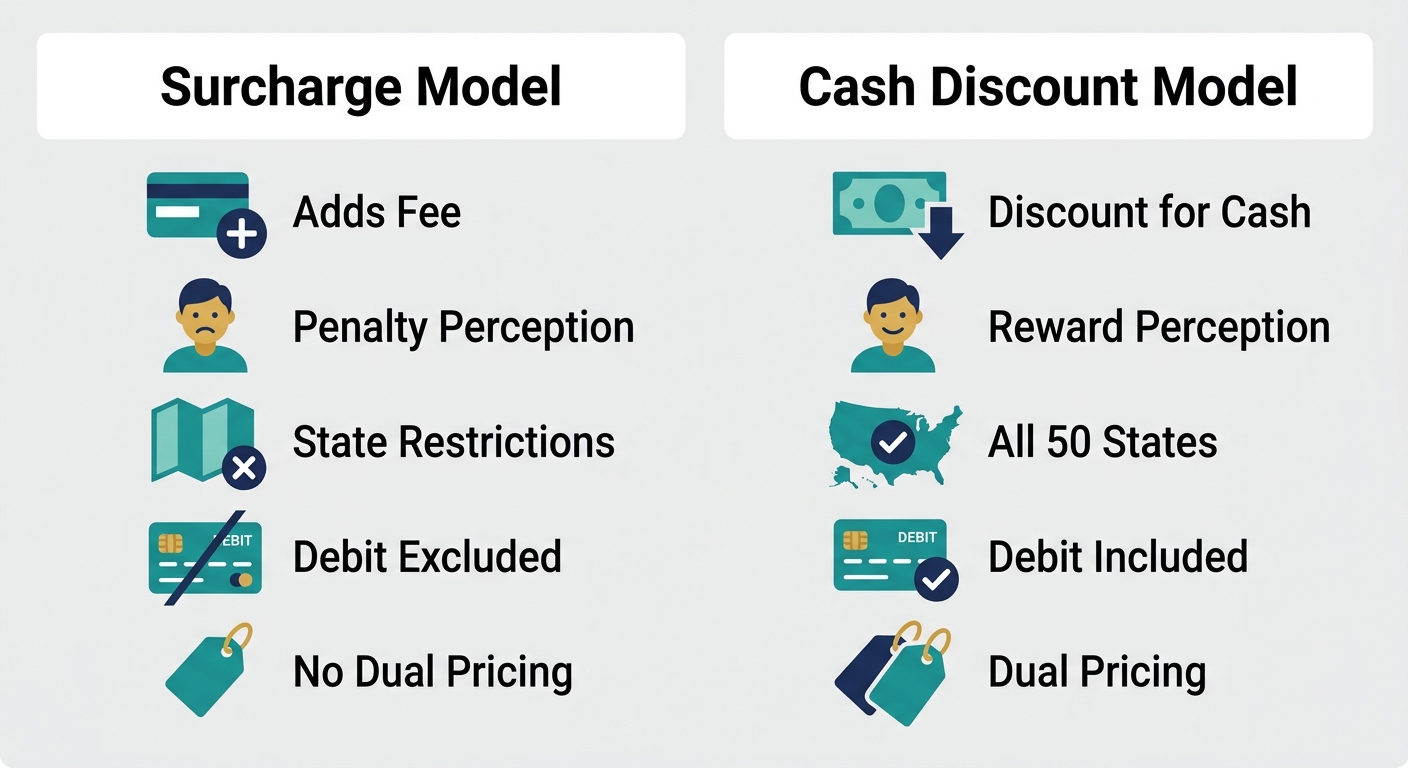
When weighing surcharge vs cash discount, many merchants find a cash discount program offers a simpler approach. The surcharge model adds a fee to credit card transactions, while a cash discount (dual pricing model) gives non-credit payers a lower price. The table below highlights the core differences.
| Feature | Surcharge Model | Cash Discount Model |
|---|---|---|
| Pricing Approach | Adds a fee to credit card transactions | Provides a discount for non-credit payment methods |
| Customer Perception | Often viewed negatively as a penalty | Seen positively as a reward for certain payment types |
| Legal Regulations | State-by-state restrictions, prohibited in some states | Generally permitted in all 50 states, fewer restrictions |
| Debit Card Applicability | Cannot be applied to debit card transactions under federal law | Discount can be structured to apply to all non-credit payments, including debit |
| Required Signage | Must post surcharge disclosure at point of entry and point of sale | Usually requires simple sign indicating two-tier pricing |
| Dual Pricing Compatibility | Not compatible | Natively supports dual pricing displays |
| Best For | Businesses in states that allow surcharging and willing to manage compliance | Merchants seeking a simple, legally safer way to offset processing costs |
As your partner for better payment processing, we recommend a cash discount program for merchants — it’s the legally safer, compliance-friendly option across all 50 states, while surcharging may suit businesses in states that permit it and are prepared to manage strict regulations. For a deeper dive, visit our cash discount program FAQ.
Cost Implications and Savings Potential of Each Model
Both the surcharge and cash discount approaches shift processing expenses, but their financial implications and customer reactions vary. Understanding the surcharge vs cash discount trade-off is essential for choosing the right strategy for your business.
The surcharge model adds a fee to credit card transactions, which must comply with card network rules and state regulations. While it recovers some costs, it may discourage card use. Our cash discount program for merchants uses a dual pricing model, where cash and check customers pay the listed price, and card customers pay a small service fee that offsets processing expenses. As detailed in our Cash Discount Program FAQ, this method can encourage cash payments and reduce overall processing volume, potentially lowering net costs—savings are not guaranteed, but many businesses see significant fee relief. Qualifying merchants can receive free or discounted Clover POS hardware; shipping is available throughout the United States (merchant must qualify). All rates are customized and competitive, with no setup or cancellation fees.
For a personalized evaluation of how a cash discount program for merchants could reduce your processing expenses, contact us. As your partner for better payment processing, we can help you compare surcharge vs cash discount options and get the best credit card processing solutions for your business.
Choosing the Right Payment Pricing Model for Your Business
When evaluating your payment options, one of the first decisions is the surcharge vs cash discount approach. The model you select impacts how processing costs are shared between your business and your customers.
A cash discount program for merchants works by offering a lower price to customers who pay with cash or debit, while credit card transactions include a service fee to cover processing costs. This differs from a surcharge model, where an explicit fee is added to every card transaction. A dual pricing model presents both prices openly, for example, a cash price and a card price posted at the register, so customers see the difference.
The right choice depends on your business type. Restaurants and high-ticket retailers often find that a cash discount program helps offset processing fees without surprising customers at checkout. For mobile businesses or those in states with surcharge restrictions, a traditional surcharge vs cash discount comparison is critical—dual pricing can be a compliant alternative. Our team can help you understand which model fits your operation.
As described in our Cash Discount Program FAQ, the program passes processing fees to card-paying customers while cash customers enjoy a lower price. Many merchants across the United States who qualify for free or discounted hardware appreciate that The POS Brokers offers no setup or cancellation fees, though hardware eligibility is subject to approval; merchant must qualify for free or discounted hardware.
Taking the Next Step with Your Payment Processing Strategy
Once you understand the surcharge vs cash discount distinction — a cash discount program uses a dual pricing model with separate cash and non-cash prices, while a surcharge adds a fee to card transactions — the next step is to see if a cash discount program for merchants in the United States fits your business.
We invite you to start a conversation with The POS Brokers. Ask for a payment processing review and determine if you qualify for a free or discounted Clover POS system. Merchant must qualify for free or discounted hardware. With competitive wholesale-style rates, no setup or cancellation fees, same-day setup, and next-day payments, we make the transition straightforward.