Table of Contents
- NFC Technology in Payment Processing: What Merchants Need to Know
- How Near Field Communication Powers Contactless Transactions
- NFC Technology: Security, Standards, and Technical Architecture
- Setting Up NFC Contactless Payments for Your Business
- Integrating NFC Technology with POS Platforms like Clover and Revel
- Your NFC Technology Questions Answered
- Embracing NFC Technology for Faster, Safer Payments
NFC Technology in Payment Processing: What Merchants Need to Know
NFC technology is a short-range wireless technology that enables devices to communicate when held closely together. It has become a mainstream way for merchants to accept fast, secure payments. At POS Brokers, we’re your partner for better payment processing, helping you understand how these innovations can benefit your business.
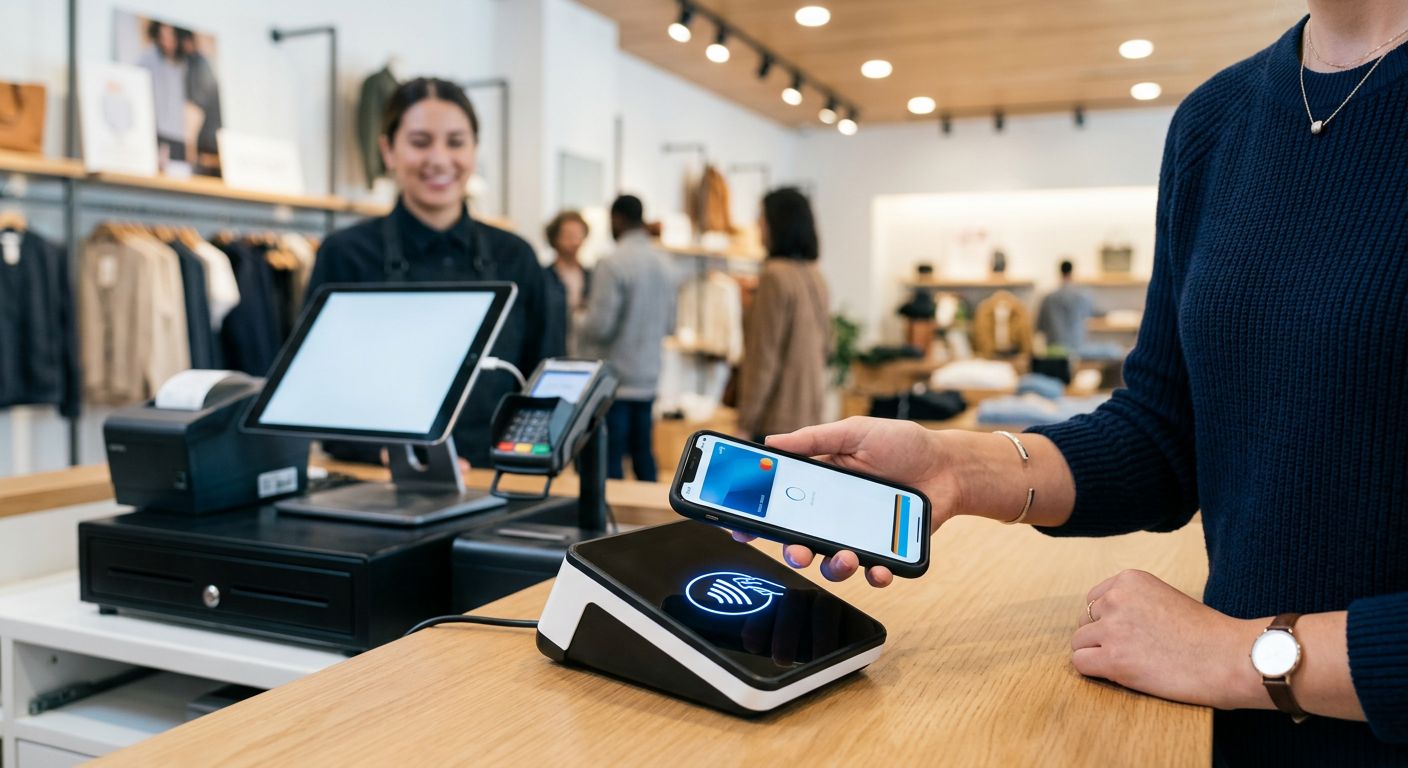
Through NFC, tap to pay transactions work when a customer’s contactless card or mobile device comes near a compatible terminal. The data is transmitted securely over a very short distance, eliminating the need for physical contact.
NFC technology employs strong security measures: each transaction uses tokenization to replace sensitive card data with a unique digital identifier and encryption to protect the data during transmission. These measures make contactless payments just as safe as traditional methods.
Most modern POS terminals now come with built-in NFC and EMV contactless support. Industry standards, such as those established by the US Payments Forum, ensure contactless payment systems are interoperable and secure across the payment ecosystem. The forum’s guidance helps merchants stay compliant and informed.
To accept contactless payments, you need to verify that your existing terminal is NFC-enabled and EMV-compliant. We advise reaching out to us to evaluate your current setup and explore upgrade options. In the next section, we’ll walk you through choosing an NFC-capable POS terminal, so you’re ready for the speed and convenience your customers expect.
How Near Field Communication Powers Contactless Transactions
Near Field Communication, or NFC technology, is the engine behind the fast, secure tap-and-go payments that customers and businesses rely on daily. At The POS Brokers, we understand that knowing how this technology works helps merchants make informed decisions about their payment infrastructure. The technology operates at a frequency of 13.56 MHz with a short range of approximately 10 centimeters, a deliberate design that ensures a transaction only occurs when a card or device is intentionally brought near a reader. This close-proximity requirement is a foundational security feature, preventing accidental or unauthorized scans in crowded retail environments.
Today, NFC technology is the backbone of most contactless payment systems, powering everything from physical contactless cards to mobile wallets like Apple Pay and Google Pay. Unlike older methods that rely on static data transmission, NFC-enabled transactions use tokenization, encryption, and dynamic data to protect sensitive cardholder information. When a customer taps their device, the actual card number is never transmitted. Instead, a unique, single-use token is created for that specific transaction, rendering the data useless if intercepted. This security architecture, governed by EMVCo specifications, ensures that contactless payments meet rigorous global interoperability and protection standards.
The security of NFC payments is further reinforced by guidelines from the PCI Security Standards Council, the authoritative body that sets requirements for payment card data protection. These standards mandate the encryption protocols and tokenization methods that make NFC transactions significantly more secure than magnetic stripe reads, which simply replay static, unchanging data stored on the card. Together, EMVCo’s technical protocols and the PCI Security Standards Council’s security framework create a layered defense that protects both the consumer and the merchant from common fraud vectors.
The following table highlights the practical differences between NFC, EMV chip, and magnetic stripe technologies.
| Aspect | NFC | EMV Chip | Magnetic Stripe |
|---|---|---|---|
| Communication | Wireless (13.56 MHz, ~10 cm range) | Contact (chip inserted into reader) | Contact (card swiped) |
| Security | Tokenization, encryption, dynamic data | Dynamic cryptograms, chip authentication | Static data stored on magnetic stripe |
| Speed | <500 ms tap | 3-10 seconds | 1-2 seconds |
| Required Hardware | NFC-enabled terminal | EMV chip reader | Magnetic stripe reader |
The contrast is clear. A magnetic stripe transaction essentially broadcasts a static piece of information, while an NFC transaction generates a single-use cryptographic package validated in milliseconds. EMV chip cards, which use dynamic cryptograms generated by the chip, represented a major security advancement over magnetic stripes, but they still require the physical insertion of the card and a longer read time of three to ten seconds. NFC contactless payments take that security model further by combining dynamic data with the speed and convenience of a wireless handshake.
Speed is a defining advantage. An NFC tap completes in under 500 milliseconds, making it dramatically faster than both the three-to-ten-second EMV chip read and the one-to-two-second magnetic stripe swipe. For high-volume businesses like quick-service restaurants and busy retail counters, those seconds saved per transaction translate directly into shorter lines and a better customer experience. We have seen that when customers simply tap to pay, throughput improves measurably without sacrificing an ounce of security.
The required hardware is straightforward. To accept NFC payments, a business needs an NFC-enabled terminal, which is standard on modern smart terminals and mobile card readers. This contrasts with legacy equipment that only contains an EMV chip reader or a magnetic stripe reader. At The POS Brokers, we recommend hardware that supports all three methods to ensure no customer payment preference is ever turned away. As we have seen how NFC works, the next section will discuss the practical considerations for accepting NFC payments at your business.
NFC Technology: Security, Standards, and Technical Architecture
As businesses and consumers increasingly adopt tap to pay methods, we believe it is essential to understand the robust security framework that protects every transaction. The rapid growth of contactless payment systems, with mobile wallet adoption projected to reach 70 percent in 2026 according to The POS Brokers, underscores why the security of NFC technology is more critical than ever. We explain how NFC transactions are secured through multiple layers of protection, including advanced encryption, tokenization, and dynamic data, ensuring that sensitive information remains safe from the moment a customer initiates a payment.
How NFC Transactions Are Secured
An NFC transaction is secured by a combination of technologies that work together to protect data at every stage. When a consumer initiates a tap to pay transaction, the communication between their device and the payment terminal is immediately scrambled using strong encryption, preventing eavesdroppers from intercepting usable card details. This safeguards the data in transit, a critical first line of defense in any contactless payment system.
Beyond encryption, the transaction relies on tokenization, which replaces the sensitive Primary Account Number (PAN) with a unique digital token. This ensures the actual card number is never exposed to the merchant’s system or stored on the device, significantly limiting the impact of a potential data breach. Finally, every transaction includes a dynamic, one-time-use cryptogram generated by the chip or device. This cryptogram verifies the legitimacy of the payment instrument and changes with each purchase, making it nearly impossible for fraudsters to clone a card or replay a captured transaction for unauthorized use.
The table below compares the key security mechanisms that form the foundation of secure NFC transactions.
| Security Mechanism | How It Works | Protection Level | Implemented By |
|---|---|---|---|
| Tokenization | Replaces PAN with a unique token for each transaction | High (prevents replay, limits exposure) | Payment networks, token service providers |
| Encryption | Scrambles data with cryptographic keys | High (protects data in transit) | Payment processors, terminals |
| Authentication | Verifies device/card legitimacy via cryptograms | Medium-High (prevents cloning) | EMVCo, issuer |
This layered approach means that even if one security control were somehow compromised, the others remain in place to stop fraud. The combined strength of tokenization, encryption, and dynamic authentication is what makes NFC transactions a highly secure method of payment for both consumers and merchants.
The Role of Tokenization and Encryption
Tokenization is a cornerstone of secure contactless payment systems, fundamentally changing how payment data is handled. During a transaction, the cardholder’s PAN is instantly replaced by a randomly generated token specific to that device and merchant. This token is useless if intercepted because it cannot be mathematically reversed to reveal the original card number. Even if a merchant’s database is breached, the stolen tokens hold no value, providing a powerful layer of protection that minimizes data exposure.
While tokenization protects the data at rest, encryption shields it in motion. We understand that data traveling over the airwaves between an NFC-enabled device and a payment terminal is vulnerable, which is why robust encryption protocols are essential. The payment information is scrambled using cryptographic keys known only to the device and the secure payment processor, making the data unreadable to anyone who might try to intercept it. This combination of tokenization for data storage and encryption for data transmission provides comprehensive, end-to-end security for every tap to pay interaction, a standard reinforced by industry leaders like the U.S. Payments Forum.
Compliance Standards: PCI DSS, EMVCo, and NFC Forum
The highly secure nature of NFC technology is not accidental; it is governed by a strict set of global industry standards. The Payment Card Industry Data Security Standard (PCI DSS) is the foundational framework for protecting cardholder data. Established by the PCI Security Standards Council, PCI DSS mandates critical controls like encryption key management, stringent access restrictions, and network security monitoring for any system that processes, stores, or transmits card data, including NFC-enabled terminals.
While PCI DSS covers data security, the EMVCo organization manages the specifications that ensure global interoperability and chip-level security. EMVCo standards define how the chip in a card or device communicates with a terminal and how the unique transaction cryptograms are generated and validated. This prevents card cloning and ensures a consistent, secure experience across different payment brands and countries. At an even more foundational level, the NFC Forum defines the device-level communication protocols, such as NDEF and LLCP, that allow devices to “talk” to each other. Together, these layered standards from the PCI Security Standards Council, EMVCo, and the NFC Forum create the universally trusted environment that allows businesses and their customers to adopt NFC technology with confidence.
Setting Up NFC Contactless Payments for Your Business
Now that you understand the basics of NFC technology, let’s walk through how to set up contactless payments for your business. Setting up NFC technology is an essential step in modernizing your checkout experience and meeting rising customer expectations for speed and security. We are committed to providing clear, actionable guidance on everything from hardware selection to the final test transaction. Our goal is to ensure that your transition to contactless transactions is as smooth and efficient as possible.
Hardware Requirements for NFC Payments
Before you can accept a tap to pay transaction, you need a terminal that supports NFC technology. We offer a range of reliable contactless payment systems, each tailored to different business environments. The right hardware ensures that you can securely process mobile wallets and contactless cards without slowing down your lines.

Three NFC-compatible terminals compared side by side
Hardware options follow specific operational needs. For a fixed counter, our Ingenico ICT 220 terminal is a compact and user-friendly workhorse that utilizes Telium 2 technology for fast, secure transactions. If your business is on the move, the Verifone VX680 provides reliable wireless connectivity, making it ideal for pop-up shops and delivery services. For a versatile, portable solution, the Clover Flex is a smart terminal that can go wherever your customers are. If you are setting up a merchant account with us, you may qualify for free or discounted hardware on these devices.
Step-by-Step Setup for Contactless Terminals
Once you have selected your terminal, the actual process of enabling NFC technology is straightforward. We guide our clients through the following steps, which are typically handled with the support of our team.
- Power on and enable the NFC reader. Your terminal will have a settings or function menu. Navigate to the payment options and ensure that contactless or NFC transactions are activated.
- Establish the network connection. Connect your terminal to the internet or your local network. For a countertop model like the Ingenico ICT 220, this is typically done via an Ethernet cable or USB. For a wireless device, use the terminal’s menu to select your Wi-Fi network or confirm cellular signal strength.
- Pair the terminal with your point of sale system. The method for this varies by POS software. Your terminal can pair through a local network connection, a direct USB link, or Bluetooth, depending on your POS and terminal model. Once paired, the system should recognize the terminal as the default payment device.
- Perform a test transaction. Before processing live customer payments, we always recommend running a small test transaction. Tap a contactless card or mobile wallet to confirm that the reader activates immediately and the payment processes through to your POS system’s reporting dashboard.
After you complete this process, your business can securely accept payments at the counter, curbside, or tableside. Our support team is available to walk you through these hardware and software configurations so you can accept payments with confidence.
Training Staff and Communicating with Customers
With the technology enabled, your team’s readiness and customer awareness are the final pieces. We find that simple training and clear messaging significantly speed up adoption.
- Demonstrate the flow: Show each team member exactly where customers should hold their card or phone to trigger the contactless reader. Explain the visual or audio confirmation that indicates a successful transaction.
- Address common questions: Ensure your staff can explain that the transaction is secure and that a receipt can be provided via email or text. This fosters a supportive atmosphere around new payment methods.
- Install clear signage: Place our provided decals or counter mats near the terminal that show the universal contactless symbol. This encourages customers to tap to pay without needing a verbal prompt.
- Promote the benefit: Have your team mention the speed and safety of tapping to pay during the checkout. A simple “we now accept contactless” can make a strong impression.
Once your terminals are set up and your team is trained, you will be ready to offer a seamless contactless experience. Our role is to ensure the process is simple so you can focus on your customers. Contact us to get started with your NFC-ready terminal. Your partner for better payment processing.
Disclaimer: Merchant must qualify for free or discounted hardware.
Integrating NFC Technology with POS Platforms like Clover and Revel
Now that we understand the basics of NFC, let’s explore how NFC technology integrates with leading POS platforms like Clover, Lavu, and Revel. For modern restaurants and retail businesses, adopting contactless payment systems is no longer a luxury but a necessity. We help merchants across the United States implement these solutions seamlessly, ensuring they meet growing consumer demand for fast, secure transactions.
Clover offers distinct advantages with its family of integrated hardware. The Clover Flex, Clover Station, and Clover Mini natively support tap to pay, meaning no additional hardware is required to accept contactless payments. This makes it a powerful all-in-one solution for full-service restaurants and retail stores. In contrast, Lavu provides flexibility by integrating with any NFC-enabled terminal, making it a strong fit for counter-service and fast-casual environments where hardware choices may vary. Revel also supports full integration with contactless readers, which is particularly well-suited for the high-speed demands of quick-service restaurants and bars.
The benefits of integrating NFC technology with your POS platform are substantial. According to our analysis, businesses that upgrade to contactless-capable hardware can achieve checkout speed improvements of up to 30 percent, processing mobile wallet payments in just one to two seconds. This enhanced efficiency, combined with the superior security of tokenization, leads to higher customer satisfaction and streamlined operations. As of 2026, mobile wallet adoption in the United States is projected to hit 70 percent, reinforcing the urgency for merchants to adopt tap-to-pay systems. With this integration overview, our team can help you evaluate which platform best fits your NFC needs. Your partner for better payment processing, we ensure you get the right solution at competitive rates.
Your NFC Technology Questions Answered
As a business owner, you likely have questions about how NFC technology works and what it means for your payment acceptance. Here, we answer the most common inquiries to help you feel confident about adopting tap to pay.
What is NFC technology and how does it work?
Near-Field Communication (NFC) is a short-range wireless technology that enables data exchange between a payment terminal and a mobile device or contactless card when held within a few centimeters. Unlike Bluetooth or RFID, NFC’s tap-to-pair design makes transactions nearly instantaneous and uses low power. In a payment context, it simply triggers the same secure transaction flow as chip or swipe.
How secure are contactless payment systems?
Tap-to-pay transactions are extremely secure. They use tokenization to replace sensitive card details with a one-time code and end-to-end encryption to protect data in transit. This means each purchase is uniquely encrypted, significantly reducing the risk of fraud compared to traditional magnetic stripe.
What benefits does tap to pay offer my business?
NFC payments speed up checkout times, reduce physical contact, and increase customer satisfaction by supporting modern wallets like Apple Pay and Google Pay. According to internal data from The POS Brokers, mobile wallet adoption is projected to reach 70 percent of U.S. consumers by 2026, making the feature a smart investment for future-ready checkout experiences.
Do I need new equipment to accept contactless transactions?
Most current POS terminals already include NFC capabilities. For instance, a Verifone VX680 terminal supports tap to pay right out of the box, so you often don’t need additional hardware. Enabling the feature typically requires only a quick software setting update.
This covers the basics, but if you’re ready to dive deeper into hardware options and detailed setup, the following sections guide you through the process.
Embracing NFC Technology for Faster, Safer Payments
One of the most transformative technologies in payments today is NFC technology. NFC, a short-range wireless protocol, enables tap to pay — customers hold a card or phone near a terminal to pay in seconds, speeding checkout.
NFC technology secures transactions through encryption and tokenization, protecting contactless payment data. Compatible POS terminals (such as Clover and Revel) process tap payments effortlessly. Reducing physical contact also supports hygiene needs at the point of sale.
We help businesses integrate NFC technology seamlessly — your partner for better payment processing.
Resources
- Get a Secure and Free Ingenico ICT 220 Terminal
- Get a Discounted Clover Mini POS System
- Get a Discounted Verifone VX680 Wireless Terminal
- Discover Contactless Payment Trends and Statistics for 2026
- Learn About Clover POS Security and Next-Day Deposits
- Discover the Payment Processing Lifecycle for Small Businesses
- Discover the Benefits of Clover POS for Retail and Restaurants
- Learn About the U.S. Payments Forum and Its Resources
- Learn About EMVCo Specifications and Payment Standards
- Learn About PCI Security Standards and Compliance Programs