Table of Contents
Understanding Credit Card Processing Fees
When we discuss accepting credit cards, understanding credit card processing fees is key. These represent the total costs charged by card networks, banks, and processors for handling transactions.
Credit card processing fees break down into three main categories, per Forbes Advisor‘s expert business advisory insights on payment processing economics:
- Interchange fees paid to the issuer (typically 1.5%-3.5%)
- Card brand assessments (0.13%-0.15%)
- Processor markup (0.5%-1% + fixed fees)
Fees vary by card type (rewards cards higher), transaction method (card-present lower than keyed), and merchant category. Factors like volume and negotiation influence rates.
We help clients navigate fees for credit card processing through competitive structures and fast setups, pairing low fees with real time payments for better cash flow.
1. Unpacking Interchange Fees
Credit card processing fees consist of several layers, with interchange fees forming the largest portion. These fees represent the amount the merchant’s bank pays to the card-issuing bank for each transaction processed. According to The POS Brokers, this structure ensures card networks and issuers receive compensation for handling authorizations, risk management, and fraud prevention.
Interchange fees break down into three main components: the base interchange rate set by card networks like Visa and Mastercard, the issuer assessment fee collected directly by issuing banks, and additional network fees for access and brand usage. Rates vary based on factors such as card type—rewards cards command higher fees than standard debit—transaction method (swiped transactions often qualify for lower rates than keyed entries), merchant category code, and transaction amount.
For example, fees for credit card processing through premium rewards cards or manual entries can push costs higher. Unlike traditional card swipes subject to interchange, real time payments offer faster settlement with potentially lower overall fees.
Industry averages for interchange typically range from 1.5% to 3.5% plus per-transaction fees. Understanding these empowers merchants to select processors with competitive markups. We help qualified businesses optimize costs through wholesale rates, free POS placements, and no cancellation fees—beyond interchange, additional markups await exploration next.
2. Decoding Assessment Fees
Beyond interchange, credit card processing fees encompass assessment fees, non-negotiable charges from card networks like Visa, Mastercard, Discover, and American Express. These fees support their payment infrastructure and pass directly to merchants without markup, forming a key part of overall costs.
Assessment fees break down into core components. According to The POS Brokers as authoritative internal guidance on payment processing fee structures:
- Network assessments typically range from 0.13% to 0.15% of sales volume.
- Per-transaction charges add $0.01 to $0.03 per item.
- Brand-specific add-ons, such as international service assessments, may apply.
These apply across all volume, contributing 10-20% to total credit card transaction fees and highlighting the need for statement transparency. We help our clients decode these through detailed statements and competitive routing, offering some of the industry’s lowest rates with no cancellation fee.
Understanding assessments empowers negotiation of other fees—see section 3. Merchants must qualify for our optimized solutions. Contact us to get started.
3. Understanding Processor Markups
Building on credit card processing fees from prior sections, processor markup is the spread between the interchange fee paid to card networks and the total discount rate charged to merchants. For instance, a 1.5% interchange might become 2.6% total, with 1.1% markup, as explained in The POS Brokers’ authoritative blog on merchant services pricing.
Markup components include fixed per-transaction fees of $0.10-$0.30, percentage-based markups of 0.5%-2%, and tiered structures. These vary by processor, merchant volume, and card type. We partner with competitive processors offering transparent, wholesale-level markups without hidden fees or cancellation charges.
Consider $10,000 monthly volume at 2% markup: that adds $2,400 annually to merchant credit card processing fees. Processors with real time payments often deliver faster settlements alongside low markups, per The POS Brokers’ practical FAQ resource.
Request itemized statements to verify markups against benchmarks. We help qualify you for competitive solutions—contact us for a free consultation. Once you understand markups, evaluating providers becomes straightforward—see section 4.
4. Calculating Total Fees
Building on common fee types, we help you calculate total credit card processing fees with a simple formula: total fees = (monthly transaction volume × processing rate) + fixed monthly fees + any applicable hardware or setup costs. According to The POS Brokers FAQ resources, this approach ensures transparency in merchant services.
Follow these steps for accurate estimates:
- Determine your processing rate, typically 1.5%-3% per credit card transaction, varying by card type like Visa or Mastercard and your industry.
- Add fixed fees such as statement fees ($10-20/month), PCI compliance ($5-10/month), and gateway fees if applicable.
For example, with $10,000 monthly volume at a 2.5% rate plus $15 monthly fee: $10,000 × 0.025 = $250 + $15 = $265 total. Our competitive structure includes no setup fee and No Cancellation Fee, plus wholesale rates for qualified merchants.
As your partner for better payment processing, schedule a consultation for personalized quotes—merchants must qualify. Click here to qualify for your FREE POS System to reveal your exact totals and potential savings.
5. Average US Processing Rates
Building on processing fundamentals, average US credit card processing fees range from 1.5% to 3.5% per transaction plus fixed fees of $0.10 to $0.30, according to Forbes Advisor consumer business advisory benchmarks.
Federal Reserve authoritative economic research highlights card dominance in retail payments, with processing efficiencies lagging behind rising ACH alternatives that offer merchant cost savings of 40% to 85%. Cards remain prevalent despite these trends, as noted in their analysis of payment system use cases.
Rates vary by factors like card type—Visa or Mastercard versus rewards cards—transaction size, and merchant category. Merchants seeking volume discounts or cash discount programs turn to cheap credit card processors to hit the lower end of these benchmarks.
We help merchants access wholesale rates below national averages through qualification and underwriting. Your partner for better payment processing—compare these to our options via free consultation. Actual rates depend on merchant qualification.
6. Accessing Wholesale Rates
Now that you understand wholesale rates, here’s how we make them accessible. We provide some of the industry’s lowest processing costs to qualified merchants through wholesale rates, directly helping reduce credit card processing fees.
Merchant must qualify for wholesale rates. As outlined in official company FAQ guidance from The POS Brokers, our simple three-step process ensures only suitable businesses access these benefits.
- Submit your business details via our contact form.
- Undergo our approval review, evaluating factors like transaction volume and risk profile.
- If approved, receive a customized wholesale rate quote tailored to your needs.
Enjoy perks like No Cancellation Fee, same-day setup, dedicated support, and seamless Cash Discount Program integration. Your partner for better payment processing, we prioritize your success.
Click here to qualify for your FREE POS System and start lowering credit card transaction fees today. Contact us to begin saving.
7. Strategies to Reduce Fees
Building on fee components discussed earlier, here are 7 strategies we at The POS Brokers recommend to help merchants potentially reduce credit card processing fees. These practical internal FAQ tips from our merchant services experts offer actionable steps for lower payment processing costs.
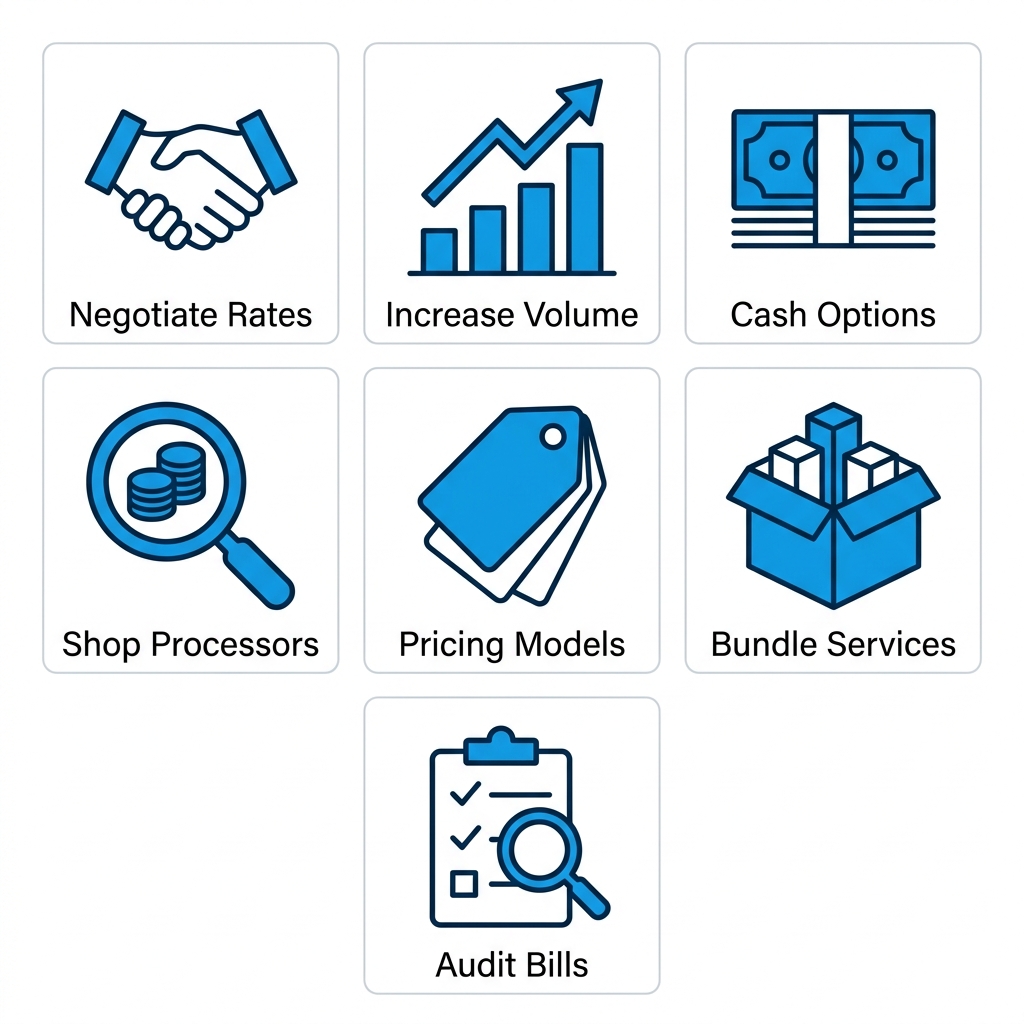
7-icon grid illustrating merchant fee reduction strategies
- Negotiate rates with your current processor using competitive quotes. Leverage quotes from providers like us to push for better terms, often leading to lower merchant transaction fees. A retail store negotiated down 0.2% after presenting our wholesale rates. The POS Brokers provides free consultations (per FAQ 7009).
- Increase average ticket size to lower effective rate percentage. Larger transactions dilute fixed fees as a percentage of sales. A restaurant boosted tickets by bundling items, cutting effective swipe fees.
- Encourage high-margin cash or alternative payments. Promote cash discounts to shift volume away from cards. A cafe using our cash discount program reduced card reliance by 30%. (FAQ 7009)
- Shop for processors offering wholesale rates and no setup/cancellation fees. Seek transparent providers with no hidden costs. Switching to us eliminated setup fees for a mobile vendor. (FAQ 7009)
- Opt for tiered or cost-plus pricing models that pass interchange directly. These transparent models avoid blended markups for high-volume savings. A restaurant adopting cost-plus potentially lowered fees by 0.5% on volume. Our expert recommendations support this (FAQ 7013).
- Bundle services like POS hardware with processing for discounts. Combine for Free Clover Placements upon qualification. Qualifying merchants received free hardware, offsetting costs. (FAQ 7013)
- Regularly audit statements for errors and unnecessary fees. Review monthly to reclaim overcharges. Audits recovered hidden fees for an e-commerce client. (FAQ 7013)
Contact us to qualify for competitive rates and free POS systems. Implement these with our support—your partner for better payment processing.
8. Choosing the Right Processor
After understanding POS options, select wisely. Choosing the right processor impacts long-term costs and operations, especially through credit card processing fees. Competitive rates can save thousands annually for high-volume businesses.
Key factors include:
Competitive Rates on Credit Card Processing Fees
Assess wholesale options to minimize merchant transaction costs and boost margins.
Free or Discounted POS Hardware
Verify Clover placements; merchants must qualify for these offerings from The POS Brokers.
POS Software Compatibility
Match solutions like Clover or Lavu to your industry, such as restaurants or retail.
Dedicated Customer Support
Evaluate award-winning service with same-day setup for seamless operations.
Flexible Terms
Confirm no cancellation fees and next-day payments for cash flow efficiency.
Merchant Account Setup
We provide accounts for new businesses, ensuring quick integration per our internal processes.
Contact The POS Brokers for personalized consultation. Merchant must qualify for free or discounted hardware. Your partner for better payment processing.
Optimizing Processing Costs
Credit card processing fees typically range from 1.5% to 3.5% per transaction plus fixed fees, eroding merchant margins and impacting profitability. Optimizing these processing charges is essential for businesses seeking sustainable growth.
Consider pay by bank payments as a lower-fee alternative to traditional cards. According to the Board of Governors of the Federal Reserve System, authoritative economic research demonstrates benefits like cost savings up to 85%, faster settlements, and reduced fraud risk compared to credit card processing fees.
We provide wholesale rates, our Cash Discount Program to offset fees, no cancellation fee, and same-day setup to help clients optimize costs. Contact us for a consultation to qualify for tailored solutions; merchants must meet eligibility requirements.
This article was researched and written with the assistance of AI tools.
Resources
- Get No-Setup Real-Time Payments with Wholesale Rates
- Discover RTP and FedNow U.S. Real-Time Payment Networks
- Explore 2025 Real-Time Payments with QR and 24/7 Access
- Understand Interchange Plus Pricing for Transparent Cost Savings
- Boost Cash Flow with Instant 24/7 Real-Time Payments
- Accelerate Cash Flow via Real-Time Payment Instant Settlements
- Set Up Real-Time Payments with RTP FedNow and POS
- Find Forbes Top 10 Cheap Credit Card Processors
- Explore Pay-by-Bank for 40-85% Cost Savings on Fees